Events
 Events
 Organization
 Organization
 News
News News
News


 REGISTER
 REGISTER


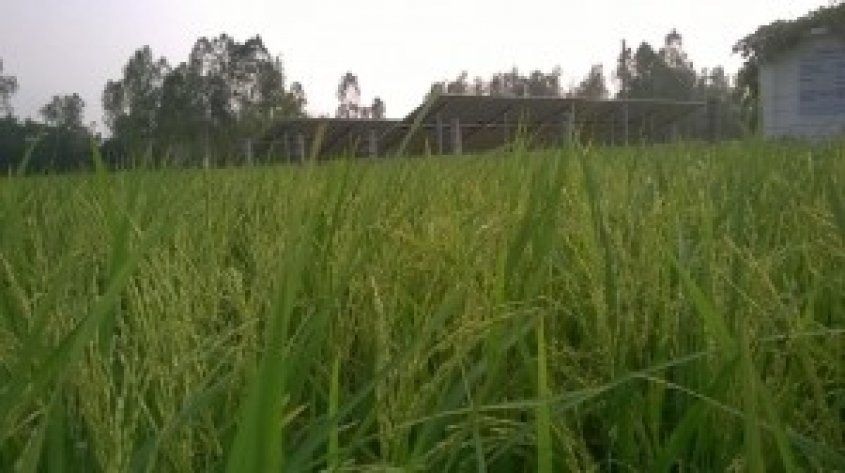
Grameen Intel Social Business Ltd. has found 21% increased crop yield and 47% decrease in fertilizer expenses per decimal land, using fertilizer recommendation software mrittikÄ, after completing a project with Rahimafrooz Renewable Energy Limited (RREL) at Mithapukur, Rangpur (North-west region). RREL is currently operating a solar power based irrigation facilities in that location.
During project from May to December 2015, 4 farmers took the recommendations for Aman rice in Kharif 2015 season. The highlight of the project is as follows:
21% increase in yield per decimal: The average yield per decimal obtained after using mrittikÄ’s recommendation is 20.52 kg as opposed to 17 kg obtained during last year.
47% decrease in fertilizer expense per decimal: The average fertilizer expense per decimal using mrittikÄ’s recommendation is BDT 15.6 while the fertilizer expense per decimal was BDT 29.4 last year.
Please find the details of the study below:
Introduction:
This report focuses on the cultivation practice and results obtained for Aman rice at Mithapukur in Kharif 2015 season, using recommendations from mrittikÄ. The season end cost and harvest results of four smallholder farmers are presented in this report, which will focus on a few important parameters and the effect of GISB’s fertilizer recommendation solution ‘mrittikÄ’ on them. A comparison of the selected parameters namely yields, total fertilizer expenditure, yield to expenditure ratio have been done against the results obtained last year for Aman rice by the same farmers.
The details of the participating farmers are as below:

Season timeline and fertilizer application pattern:
Farmers applied fertilizers in 3 phases after getting the recommendation from mrittika:
• First dosage: immediately after seedling establishment
• Second dosage: at early tillering stage
• Third dosage: 5-7 days before panicle initiation (PI) stage)

Focus parameters:
The following parameters were given primary attention to analyze the impact of mrittikÄ’s recommendation on
the cultivation and harvest of Aman rice:
• Crop yield: To capture the total yield received by the farmers, as well as the yield per decimal of land.
• Fertilizer expense: To record and analyze the cost of fertilizers required for the particular season and fertilizer
expense for per decimal of land.
• Ratio of total yield and total expenditure: To explain the total return on fertilizer investment and
the cost needed to produce 1 kg of Aman rice.
Harvest Data Analysis:
This section shows the graphical representation and analysis of the crop yield, fertilizer expense and the yield to
expense ratio.
a. Crop yield per decimal

The graph points out the fact that the farmers had more crop yield per decimal this season using
mrittika’s recommendation than last season.
b. Fertilizer expense per decimal

The graph above explains that the farmers spent more on fertilizers in the last season. However, in this season after using mrittikÄ’s recommendation the cost of fertilizers has gone down significantly.
c. Ratio of total yield and expenditure

After using mrittikÄ’s recommendation, the farmers were able to get better total yield to total expenditure ratio, implying the fact that the farmer’s using mrittikÄ’s recommendation were able to harvest more of rice (in‘Kg’) for ‘per taka’ spent on fertilizers.
Highlight of the season:
The intervention with GISB’s e-Agriculture solution where mrittika was used were able to generate the below impact for the smallholder farmers compared to last year when traditional farming practice was followed:
• 21% increase in yield per decimal
The farmers were able to obtain 21% increase in yield per decimal using mrittikÄ’s recommendation. The average yield per decimal obtained after using mrittikÄ’s recommendation is 20.525 kg as opposed to 17 kg obtained during last year.
• 47% decrease in fertilizer expense per decimal
The farmers experienced significant decrease by 47% in fertilizer expense per decimal after using mrittikÄ’s recommendation. The average fertilizer expense per decimal using mrittikÄ’s recommendation is 15.6 taka while the fertilizer expense per decimal was 29.4 taka in last year.
• Higher yield to expenditure ratio
The average ratio of yield and expenditure obtained this year using mrittikÄ’s recommendation is 1.47 which is much higher compared to average ratio of total yield and total expenditure of 0.59 obtained last year. This implies that the farmers using mrittikÄ’s recommendation this season were able to attain on an average 1.4 kg of aman rice for each taka spent on fertilizer; compared to last season where the farmers attained 0.59 kg of Aman rice for each taka spent on fertilizer.
APPENDIX
Harvest results: The table below gives an idea on the total yield and the expenditure associate with growing Aman rice this season.
After using mrittikÄ’s recommendation (This season)

Before using mrittikÄ’s recommendation (Last season)


Prof Dr Muhammad Yunus said no one should be unemployed, no problem can remain unresolved. Africa is one of the regions with the highest potential...

The 5th Social Business Design Lab took place at Yunus Centre on 15 June 2013. The participants from different organizations including Ms Pauli...

Nobel Peace Prize winner Prof Muhammad Yunus has called for an international minimum wage for garment factory workers to shield them from exploita...

16 February, 2017In the last several days there have been strong accusations made against ...
Read More
Tokyo Governor Seeks Yunus' Advice for 2020 Tokyo Summer Olympic and women entrepren...
Read More Events
 News
News